


Introduction
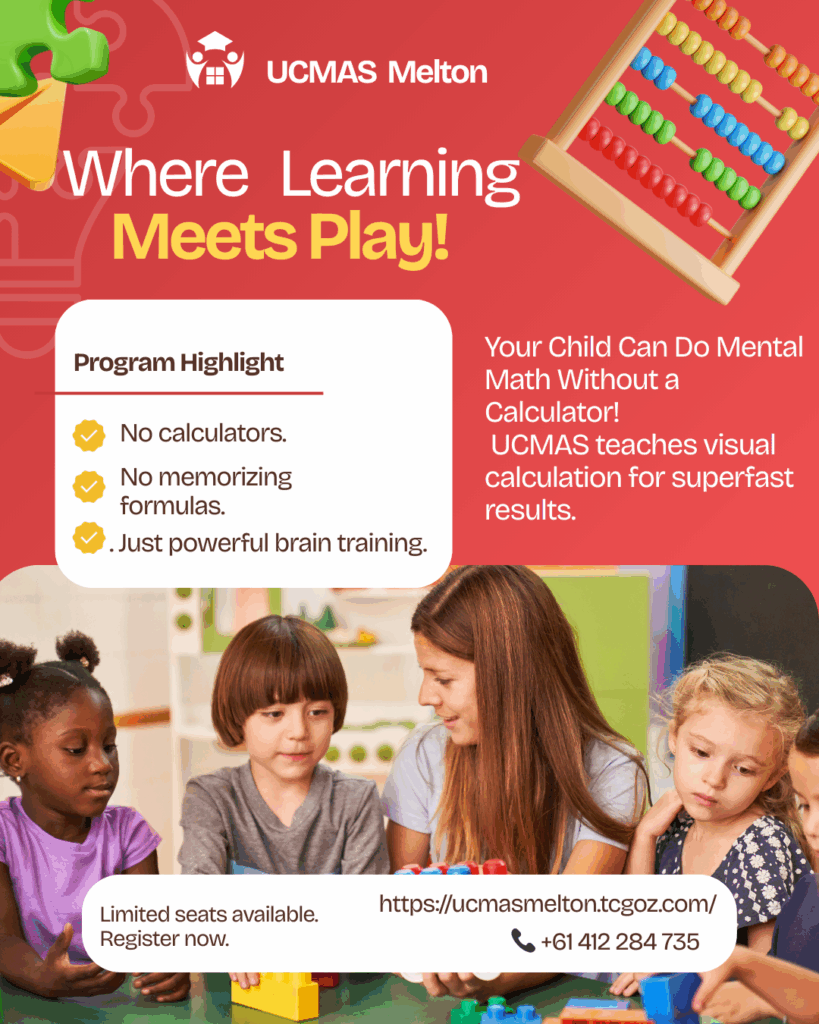
In a world where tablets, calculators and smartphones dominate, you might ask: Why teach our children the old-school tool, the abacus? The answer is simple: because the abacus doesn’t just teach arithmetic—it builds cognitive skills, focus, mental agility and a strong foundation for future learning. For children in Australia, enrolling in an abacus and mental maths programme like UCMAS Melton can mean giving them an edge in both school and beyond.
Why the abacus still matters today
Unlike calculators which simply provide answers, the abacus requires children to visualise, manipulate, and internalise number relationships. Research shows that abacus training enhances working memory, concentration and brain-function.
In the digital age, attention spans are shorter and distractions many. An abacus-based class offers a structured, tactile and focused practice that helps children develop sustained attention and mental discipline.
Abacus training stimulates both hemispheres of the brain: the logic and the visual/spatial part. This combined brain-development is seldom achieved just by screen-based tools.
The competitive advantage for school, exams & life
Speed & accuracy in calculations – Whether it’s a timed test at school, a maths Olympiad or simply checking bills and spending the right way, kids who train with abacus develop calculation speed and reliability.
Footprints Childcare
Better focus across subjects – Maths is just one subject. The focus, memory and concentration that come from abacus classes transfer to science, reading comprehension, design, and even sports.
Confidence & self-esteem boost – As children realise they can solve sums quicker, with less error, they gain confidence—and confident students are more likely to participate, lead and succeed.
Future-proof skills – Even as AI, automation and digital tools advance, the ability to think before you compute, to visualise numbers, to reason and to solve mentally will remain a distinct human advantage.
Reduced math anxiety – Many children fear maths. Abacus training helps them move from “I-can’t” to “I-can” by making maths fun, visual and interactive rather than abstract and scary.
What to look for in a good abacus programme (and why UCMAS Melton fits)
- When choosing an abacus & mental maths centre, parents should check:
- A structured curriculum with progression from physical abacus to mental calculation
- Certified and child-friendly instructors
- Class sizes, interactive lessons, and regular practice/homework
- A results-oriented approach (focus, memory, accuracy), and an engaging, fun format
For Melbourne’s western suburbs, UCMAS Melton offers all of the above: a globally-recognized brand with local delivery, fun classes for ages 4-13, and the right mix of challenge and encouragement.
How parents & students can maximise the benefit
Stay in touch with the centre (UCMAS Melton) to monitor progress and set goals
Ensure regular attendance and home practice (even 10-15 minutes daily adds up)
Encourage children to visualise the abacus (help them transition from physical beads to mental beads)
Use everyday opportunities: ask mental-math questions during shopping, travel, cooking etc.
Celebrate small wins (faster time, fewer errors) to keep motivation high
Conclusion & call-to-action
In a digital age overflowing with gadgets, the abacus stands out not because it is old—but because it works. By enrolling your child in an abacus programme, you’re not just teaching them how to calculate—you’re equipping them with brain-training, self-belief and academic readiness. For families in Melton and surrounding areas, UCMAS Melton offers that opportunity.

Leave a Reply